
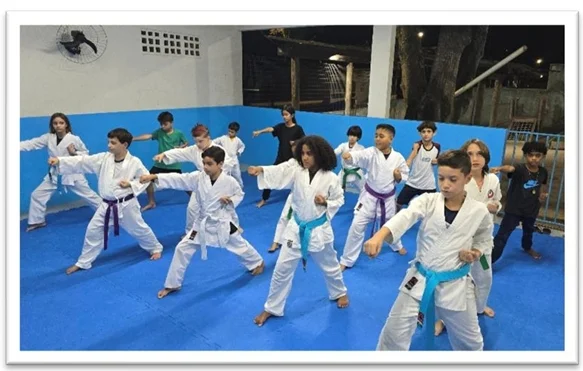
With my experience in classes, both karate and jiu-jitsu for children, I observe that a question appears almost recurrently. In fact, I would be lying if I said this only happens to children. This same question often comes from parents and even adult students.
I don't know if I can judge them for that. After all, I'm pretty sure that, at some point, we've all asked — if not to our teachers, then to ourselves — this question:
“How long will it take for me to reach my black belt?”
This question seems simple, but it reveals something very common: we are often so focused on the end goal that we end up forgetting to pay attention to the path to it.
With that in mind, I imagined a little story to tell my students. A simple story, but one that perhaps helps you better understand what really matters on this journey.
I would like to share this story with you.
The History of the Castle and the Key
Imagine a traveler walking along a very long road. Those roads that never seem to end. At one point he looks up and sees, right there on the horizon, a huge castle. Tall towers, strong walls, a truly impressive construction. When he sees that, he immediately thinks: “I need to get to this castle.” Then he starts walking.
From the first step, however, something curious happens. His eyes are always fixed on the castle. He walks looking only ahead, thinking about the moment when he will finally get there. Time passes and he continues walking, but without paying much attention to the path. And there were a lot of interesting things on that road.
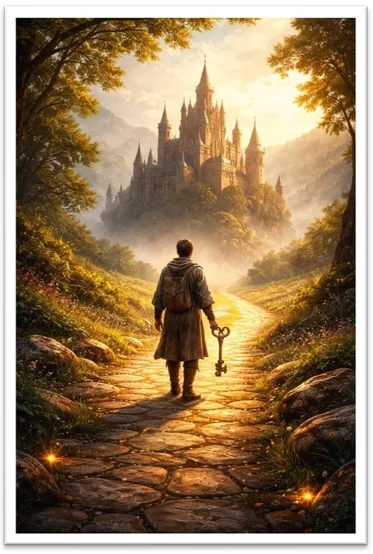
Different flowers grew on the sides of the path, some very rare. Colorful birds sang in the trees. In certain areas, stones sparkled on the ground when the sun hit them. And most curious of all: in some parts of the road, the bricks themselves were made of gold. But he saw none of that. Not because he wasn't there, but because he was too busy just looking at the castle.
After a long time of walking, he finally arrives. The castle was even bigger up close. The walls were high, and there was a huge gate at the entrance. He takes a deep breath and thinks: "There. I did it." Then he puts his hands on the gate and tries to push it. Nothing happens. He tries again, harder, but the gate remains closed. It was locked.
It was then that he noticed a guard standing to the side. The traveler says: "I walked so far to get here. I want to enter the castle." The guard looks at him calmly and asks just one thing: “Did you bring the key?”
The traveler is confused and responds: "Key? What key?"
Then the guard explains that, right at the beginning of the road, there was a sign saying that the first piece of a key would be found in that place. The sign also said that, along the entire path, other parts of this key would appear to anyone paying attention. Anyone who paid attention to the road could gather all the pieces and, upon arriving at the castle, they would have the complete key to open the gate.
The traveler is silent. He even vaguely remembers seeing a sign at the beginning of the path… but he passed right by. I was just looking at the castle.
At that moment he realized something important. During the entire walk he had passed many valuable things and had not noticed any of them. He didn't see the rare flowers, he didn't hear the birdsong, he didn't notice the shining stones or the golden bricks that formed the road. He walked all the way, but didn't pay attention to him.
The guard then said something simple, but full of meaning. He said that the castle was important, but that it only opened to those who had the key. And that key wasn't in the castle. She was in the way.
The lesson of history applied to karate
Now that we've heard this story, it's worth returning to the question that appears so often in classes. Anyone who has been training karate for some time has seen this happen: the student starts and then asks “Sensei, when is the next exam?”, “How long does it take to change belts?” or “How long does it take to reach black belt?”. And that's normal. At some point, practically every practitioner thinks about this.
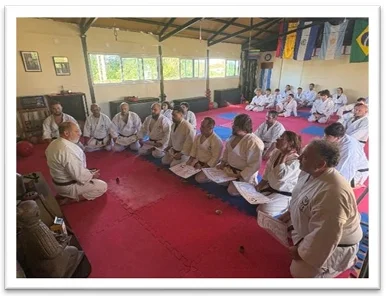
Over time, however, we began to realize something important. The black belt is a bit like the castle in the story. At first glance it seems like the ultimate goal, but it's actually just a door. What really transforms us is the path towards it: repeating a kihon many times until we understand a detail, training a kata several times until we notice something new, receiving a correction, adjusting and continuing training.
When someone looks only at the banner, they end up being like the traveler who walked looking only at the castle. He may even get there, but he runs the risk of losing everything the path had to teach. That's why it's worth reflecting: when we go in to train, are we just looking at the castle or are we learning to walk?
Because, deep down, the black belt marks precisely the moment in which we begin to understand the path.
A philosophical dive
In general, many of us, whether we practice karate, other martial arts or even the goals in our lives, believe that the value lies in the end goal and not in the search process. Several oriental martial arts already bear the importance of the path (Dō – 道) in their own name. However, it is important to highlight that, at times, several philosophers from Western culture also highlighted the importance of the path, of seeking, even before the so-called “final truth”.
One of these philosophers was Socrates (469 BC – 399 BC), known as one of the founders of moral philosophy. Born and lived in Athens, capital of Greece. He argued that, in the act of recognizing one's ignorance, true wisdom lies. The famous phrase attributed to him — “I know that I know nothing” — precisely expresses the idea that learning is always continuous. The so-called “art of midwifery” was a method created by Socrates, inspired by his mother, who was a midwife. He used questions directed to his interlocutor, guiding him so that he could “give birth”, through dialogue, to his own knowledge. This method became known as maieutics.
Another philosopher who followed a very similar line of reasoning was Plato (427 BC – 347 BC). It is not surprising that he was a disciple of Socrates and also the founder of the Academy of Athens. Plato taught that knowledge is not just about possessing the truth, but involves a constant movement in search of understanding reality. This idea appears emblematically in the allegory of the Myth of the Cave, presented by Plato in his work The Republic, where knowledge is demonstrated as a gradual process of liberation and discovery.
Following this same historical lineage, we arrive at Aristotle (384 BC – 322 BC). This, in turn, was a student of Plato and founder of the Lyceum. Aristotle states that virtue — or human excellence — is related to the constant quest to become a better version of oneself. According to him, this excellence does not appear immediately, but is built day after day through habits and constant practice. We thus come to the conclusion that the training process is as important as the final objective.
Taking a temporal and also geographical leap, I could not fail to mention Gotthold Ephraim Lessing (1729 – 1781), German playwright and philosopher of the Enlightenment. In his work Eine Duplik, he wrote a very striking statement on this topic: "If God held all truth in His right hand, and in His left only the ever-living impulse to truth... and said to me, 'Choose!', I would fall humbly upon His left hand and say, 'Father, give it to me! For pure truth is for You alone!'" Thus, Lessing makes it clear that, between possessing absolute truth or continuing to seek it, he would choose the search. The continuous effort of investigation and intellectual improvement reveals, for him, the highest value of the human spirit.
Thus, we can see that for millennia there has been a recurring thought: human knowledge should not be seen as a final point of arrival, but as a continuous process of investigation, learning and transformation.
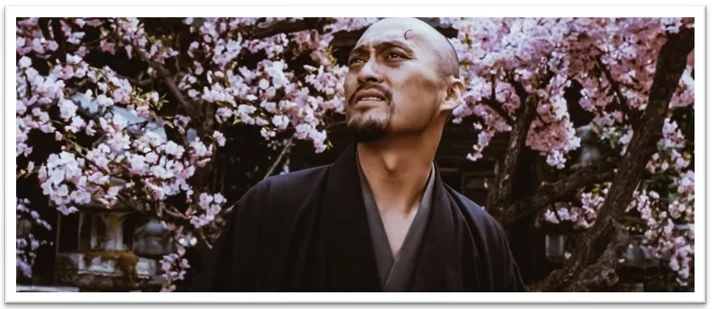
There is a phrase said in the film The Last Samurai (2003) that, in a way, sums up this idea well: "The perfect flower is a rare thing. You could spend your whole life looking for one, and it wouldn't be a wasted life."
Perhaps this is exactly what many of these philosophers tried to teach us. The sincere search for knowledge — even if it is never definitively achieved — is, in itself, a life well lived.