
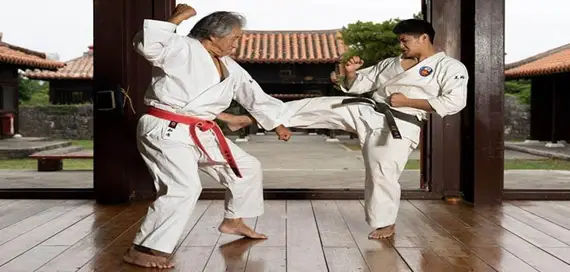
The Pinan, also known as Heian in traditions such as Shotokan, form a series of five kata. Practiced individually or in groups, they allow you to study postures, movements and combinations of movements in a sequence that can be revisited and deepened throughout the training.
Anko Itosu and teaching in Okinawa
The series is associated with Anko Itosu, who played an important role in spreading karate in Okinawa schools. They are known as Pinan Shodan, Nidan, Sandan, Yondan and Godan. The order, names, and execution details vary by lineage. In Shotokan, the series spread under the name Heian.
There are hypotheses about the influence of previous kata, such as Kushanku, and a form cited as Chiang Nan. The available documentation more clearly supports the series' association with Itosu and the teaching of beginners. The exact origins of the movements and the proposed dates deserve to be presented as open historical questions.
What the name can express
Pinan and Heian are readings associated with the characters 平安. Peace, tranquility and security appear in interpretations of the name. Some authors relate the expression to the idea of traveling the karate path safely. This reading gives meaning to the practice, although the original intention of the name requires its own historical source.
What the sequence teaches
The five kata offer gradual challenges in coordination, balance and body control. Variations in direction, pitch and rhythm create opportunities to study combinations and applications. Pair training helps you explore these possibilities with distance, time, and intention.
For those who practice Goju-Ryu at Jundokan, the Pinan offer a window into the broader history of Okinawan karate. In the AKKKA program, kata such as Gekisai, Saifa and Sanchin play their own roles in the practitioner's training.